Article
Jul 12, 2026
CardiologIA Madrid 365: What Spain's Public Health System Just Proved About Remote Cardiac Monitoring
Hospital Ramón y Cajal launched a 24/7 AI-powered cardiac monitoring program in November 2025. Here's what the verified results show — and what they mean for the future of heart failure care.

CardiologIA Madrid 365: What Spain's Public Health System Just Proved About Remote Cardiac Monitoring
Spain's public health system just ran the experiment. Here are the results.
On 23 June 2026, Isabel Díaz Ayuso, President of the Comunidad de Madrid, presented the first verified outcomes of CardiologIA Madrid 365 — a 24/7 AI-powered remote monitoring program for cardiac patients, operating from Hospital Universitario Ramón y Cajal since November 2025.
The numbers, pulled directly from the official presentation: 28,000 patients monitored, more than 11,000 clinical alerts managed, 400 of them classified as critical. Decompensations that, as Ayuso put it, "could have been serious and some irreversible" — caught before they became emergencies.
What CardiologIA Madrid 365 actually does
The programme monitors patients with heart failure, arrhythmias and ischaemic heart disease around the clock, every day of the year. Patients are connected through the regional Virtual Health Card app and through connected devices installed at home: smart scales, blood pressure monitors, pulse oximeters, wearables and portable ECG monitors. These devices feed a central platform that continuously analyses each patient's data against their individual clinical history, lab results, medication records and environmental factors.
The control centre at Ramón y Cajal runs 10 monitoring stations staffed by cardiologists and nurses, in front of a 22-square-metre digital panel displaying real-time patient status. When the system detects a pattern associated with clinical deterioration, it generates one of approximately 170 protocolised alerts, classified by severity. Depending on the level, the response ranges from a teleconsultation or treatment adjustment to an urgent referral or direct coordination with Madrid's emergency services (SUMMA 112).
Dr. José Luis Zamorano, Head of Cardiology at Ramón y Cajal, described the programme as the shift from reactive to proactive medicine: "The best hospital bed is the one we don't have to use." Carlos Mingo, the hospital's director, outlined the model's three axes: moving from episodic to continuous care, applying a prevent-adapt-predict framework, and transforming the health system through advanced use of data.
Ayuso framed the initiative clearly: "CardiologIA Madrid 365 will allow us to follow in complete detail how each patient evolves, every day of the year, wherever they are."
Why this matters beyond the headline numbers
This is not a pilot. It is a public health programme, running at scale, with verified outcomes presented by the regional government. That is a meaningfully different category of evidence from a controlled clinical trial or a vendor-funded study.
It also adds another data point to a growing body of evidence that daily remote monitoring of cardiac patients changes outcomes — alongside published results like the HeartLogic multicenter study across 19 Spanish hospitals and 400 patients, which found remote monitoring reduced hospitalisations and outpatient decompensations by 50% (Revista Española de Cardiología, 2024), and Germany's TIM-HF2 trial, which reached similar conclusions.
The pattern across these independent datasets is consistent: when clinical teams can see what is happening between visits — not just at the next appointment — they intervene earlier, and patients stay out of hospital.
Where Sensocor ML fits in this picture
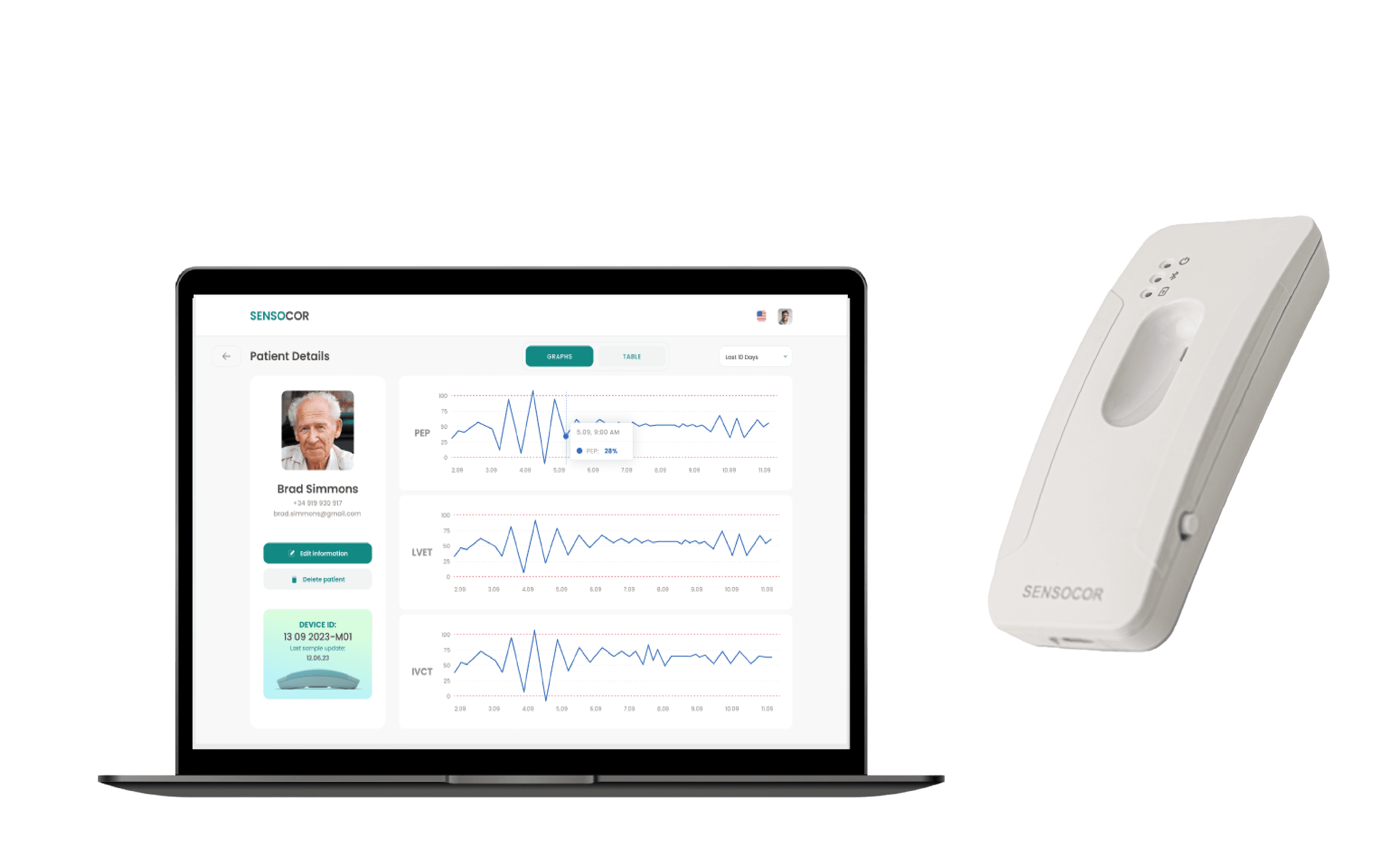
CardiologIA Madrid 365 works through hospital infrastructure and the regional Virtual Health Card — it reaches patients already connected to the Ramón y Cajal system. That is its strength, and its boundary.
At Monitoring Life, we started in 2020 with a question a group of cardiologists asked us: how do you follow a patient you cannot safely bring into a hospital? What CardiologIA Madrid 365 confirms is that the answer to that question matters enormously — and that daily visibility into a patient's cardiac status, before deterioration becomes an emergency, is now something Spain's public health system is actively building toward.
Sensocor ML is working on the same daily visibility, through a different route: a non-invasive multimodal device combining ECG, phonocardiogram (PCG) and photoplethysmography (PPG) signals, captured in 30 seconds, from any patient's home — without requiring hospital infrastructure or an existing connected device. The goal is to extend this kind of monitoring to the patients who are not yet inside any programme: those discharged from a hospital that does not yet have CardiologIA Madrid 365, those whose GP does not yet have a monitoring protocol, those whose cardiologist is seeing them twice a year and hoping nothing goes wrong in between.
The debate is no longer whether remote cardiac monitoring works.
It is how to reach every patient who still does not have access to it.
Sources: