Resources
Mar 26, 2026
How AI Is Changing Arrhythmia Management
🎙 The Future of Heart Monitoring Starts at Home Cardiovascular care is undergoing a quiet but powerful transformation. What once required frequent hospital visits and reactive interventions is now shifting toward continuous, proactive care — and it’s happening right at home. Recently, Vicente Copoví, Carlos Porras and Dr. Fernando Arribas joined Radio Libertad, invited by Marga De La Fuente, to discuss one of the most pressing challenges in modern healthcare: heart failure monitoring.
Introduction
Cardiac arrhythmias don't announce themselves.
One day your patient's implantable device is humming along, transmitting normal data. The next week, atrial fibrillation episodes spike. By the time the clinic reviews the remote monitoring alert, the patient has already been living with increased arrhythmic burden for days.
What if we could see it coming before it happened?
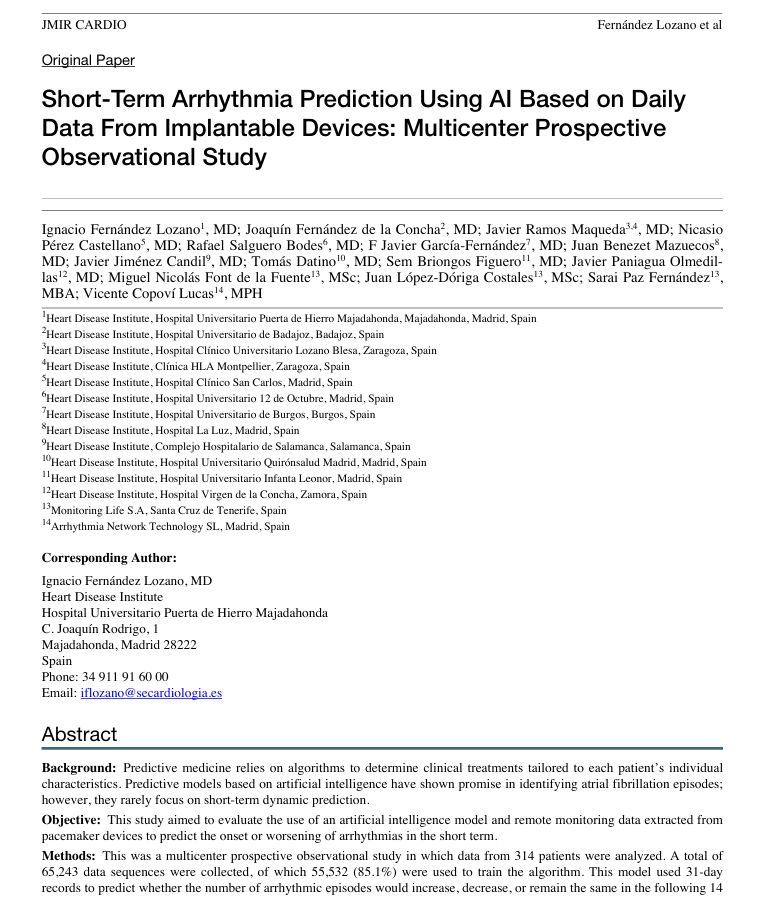
That's not a hypothetical anymore. A new multicenter prospective study published in JMIR Cardio demonstrates that AI can predict short-term changes in arrhythmic episodes using daily data from implantable cardiac devices—addressing one of cardiology's most challenging clinical needs: dynamic, short-term prediction.
The Problem With Reactive Monitoring
Remote monitoring of cardiac implantable electronic devices (CIEDs) has transformed arrhythmia management. Patients no longer need frequent clinic visits. Clinicians receive continuous streams of intracardiac data. In theory, it's a perfect system.
In practice? It's reactive, not proactive.
Current remote monitoring systems generate high volumes of device alerts, and more than 50% of all alarms are false positives. Clinicians spend hours triaging transmissions, separating noise from signal. And even when the alert is real, it's reporting something that already happened—not something that's about to happen. PubMed Central
The clinical question isn't just "Did arrhythmic burden increase?" It's "Will it increase in the next few days, and should we intervene now?"
That's the gap AI is starting to fill.
What The Study Actually Did
The research team—including collaborators from Monitoring Life and Arrhythmia Network Technology—analyzed 314 patients and more than 65,000 data sequences from implantable cardiac devices.
The goal: develop a machine learning model that could predict short-term increases or decreases in arrhythmic episodes based on daily remote monitoring data.
Here's what makes this study different from previous AI arrhythmia research:
It's prospective. Not a retrospective analysis of old data, but real-world validation in actual clinical workflows.
It's dynamic. The model predicts changes in arrhythmic burden over days—not just whether arrhythmia is present or absent. nih
It's device-agnostic. The approach works with standard remote monitoring data streams, not specialized sensors.
The Results: Promising
The model achieved a global sensitivity of 66.4% and specificity of 77.4%. For patients with baseline arrhythmia, sensitivity jumped to 76.8%. nihnih
Translation: The AI correctly identified about 3 out of 4 patients whose arrhythmic episodes were about to increase—before they increased.
Is that perfect? No. But it's clinically meaningful.
Think about it this way: If your remote monitoring dashboard flagged three patients today as "high risk for arrhythmia increase in the next 72 hours," and you proactively adjusted medications or scheduled earlier follow-up, you've just shifted from reactive to predictive care.
You're not waiting for the alert. You're preventing the alert.
Why This Matters Beyond Arrhythmias
This study is about more than atrial fibrillation prediction. It's a proof of concept for something bigger: continuous, predictive cardiology.
AI is transforming cardiac electrophysiology across the entire care pathway—from arrhythmia detection to therapeutic personalization. But the real value isn't replacing clinicians. It's augmenting clinical judgment with dynamic risk stratification. uspto
Here's the pattern we're seeing across cardiovascular AI:
Static risk scores (CHADS₂-VASc, HAS-BLED) tell you population-level risk
Remote monitoring tells you what happened yesterday
Predictive AI tells you what's likely to happen tomorrow
That third layer—the predictive layer—is what changes workflows.
Instead of managing 150 patients reactively, you're triaging based on predicted decompensation. Instead of reviewing every transmission equally, you're prioritizing the three that matter most right now.
The Sensocor ML Philosophy
At Sensocor ML, we approach this from a different angle.
While this study focused on implantable devices and arrhythmias, we're asking: What if we could detect hemodynamic deterioration before arrhythmic episodes even start?
Our platform combines mechanical biomarkers (PEP, IVCT, LVET) with AI to surface early changes in cardiac function. Not just rhythm. Function.
Because arrhythmias don't happen in a vacuum. They happen when the heart is stressed, when filling pressures rise, when compensation mechanisms fail. If we can detect those upstream changes, we're not just predicting arrhythmias—we're predicting the conditions that cause them.
The patient uses a simple, non-invasive device daily. The AI processes the mechanical biomarker data. The clinical dashboard surfaces actionable insights.
Predictive, not reactive. Proactive, not panicked.
The Shift Is Already Happening
Deep learning models have achieved cardiologist-level performance in rhythm classification, with arrhythmia classification accuracy of ≥95%. We're past the "does it work?" question. uspto
Now we're in the "how do we deploy it?" phase.
And that's where companies like Monitoring Life, Arrhythmia Network Technology, and Sensocor ML come in—not just building models, but building systems that fit into real clinical workflows with real patients.
Because the future of cardiology isn't more data. It's better predictions.